Apple Launches the M6 Mac mini: Price, Release Date and What Changed
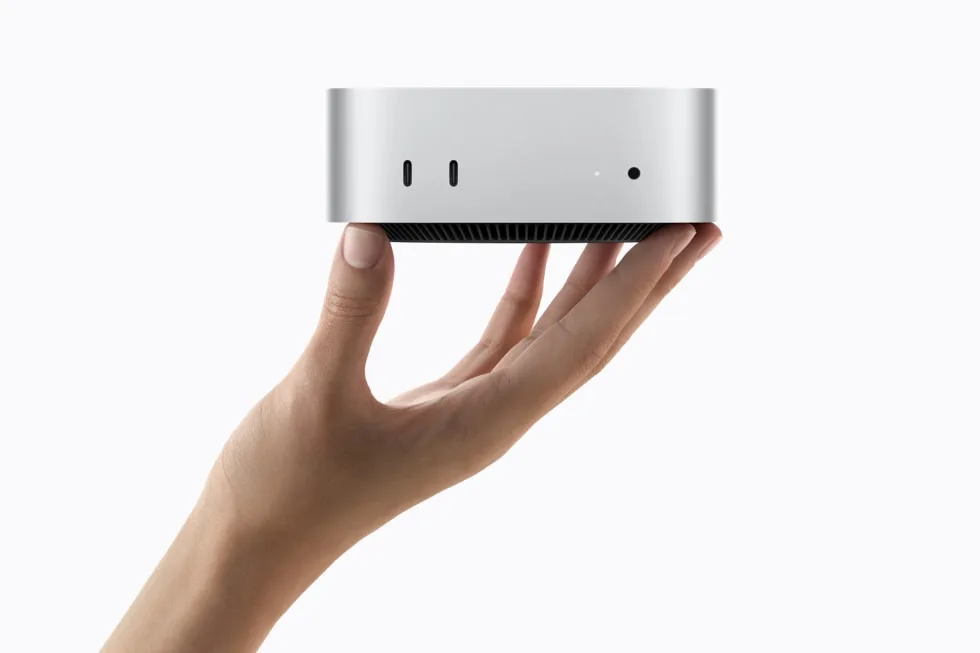
Apple has announced a new Mac mini powered by the M6 chip, with U.S. pricing starting at $899 and customer availability beginning September 22, 2026. Pre-orders opened on August 25, while a higher-performance M5 Pro configuration starts at $1,699.
The compact enclosure remains familiar, but Apple is positioning this generation around local AI performance, faster graphics and storage, and upgraded networking.
M6 Mac mini price and release date
Apple’s confirmed U.S. pricing is:
- Mac mini with M6: from $899, or $799 with education pricing.
- Mac mini with M5 Pro: from $1,699, or $1,599 with education pricing.
Orders opened August 25 in 30 countries and regions. Apple says deliveries and in-store availability begin September 22. Configuration prices vary with memory, storage and networking options.
What is new in the M6 Mac mini?
The standard M6 model combines a 12-core CPU and 12-core GPU. Apple says the GPU brings Neural Accelerators to each core on Mac mini for the first time, alongside a Dual 16-core Neural Engine.
The base configuration includes 16GB of unified memory and can be configured with up to 32GB. Apple lists memory bandwidth of up to 170GB/s.
Connectivity also receives a meaningful update:
- Wi-Fi 7
- Bluetooth 6
- 2.5Gb Ethernet as standard
- Optional 10Gb Ethernet
- Two front USB-C ports
- Three rear Thunderbolt 4 ports on M6 models
- HDMI and a headphone jack
The M5 Pro version replaces the rear Thunderbolt 4 connections with Thunderbolt 5 and supports more demanding expansion and clustering workflows.
How much faster does Apple say it is?
Apple claims the M6 version delivers up to four times faster AI performance, twice the graphics performance and 40 percent faster CPU performance than the M4 Mac mini in selected tests. It also claims storage performance is up to twice as fast.
Those are manufacturer results under specific configurations and workloads, not universal speed guarantees. The gain a buyer sees will depend on the application, model size, memory configuration, cooling behavior and whether the software can use the new accelerators.
Apple’s detailed examples include faster prompt processing in LM Studio, improved spreadsheet calculations and higher ray-tracing performance in a named game. Independent testing will be needed to show how these claims translate to everyday use.
Why Apple is emphasizing on-device AI
The announcement repeatedly presents the Mac mini as an always-on or deskside system for AI agents and local models. On-device processing can keep some data on the computer, reduce dependence on a cloud connection and avoid per-request cloud fees. It can also be constrained by local memory and model compatibility.
That distinction matters. Many people use AI entirely through a browser and do not need a specialized local machine. Our explanation of what artificial intelligence is and how it works separates models, applications and common marketing language, while our list of free AI tools that work without login shows how much can already be done through lightweight web services.
For local workloads, memory is especially important because CPU, GPU and Neural Engine performance do not remove the need to hold model data. See our practical guide to how much RAM Windows 11 and AI tools need for a broader explanation of cloud versus local AI memory requirements. Although the platform differs, the buying principle is similar: choose capacity based on a known workload rather than an “AI” label.
What does the M5 Pro model add?
The M5 Pro configuration is aimed at developers, video professionals, 3D artists and other users with sustained demanding workloads. Apple says it can be configured with up to an 18-core CPU, 20-core GPU and 64GB of unified memory, with memory bandwidth reaching 307GB/s.
It also brings Thunderbolt 5 and supports genlock over USB-C for synchronized production environments. Apple highlights larger local models, high-resolution video, scientific simulations and complex creative projects as target uses.
For ordinary documents, browsing, streaming and light creation, those capabilities may be unnecessary. The standard M6 model is the more relevant comparison for most home and small-business buyers.
macOS 27 and Siri AI
The new Mac mini will run macOS 27, which Apple says includes the next generation of Apple Intelligence and Siri AI. The company describes deeper personal context, on-screen understanding, cross-app actions and new automation capabilities.
However, Apple states that Siri AI is currently available for testing and is expected as a beta later in 2026 for supported devices set to English. Feature, language and regional availability can vary, so buyers should not assume every demonstrated software feature will be complete on the hardware’s first shipping day.
What did not change?
The Mac mini remains a compact desktop that requires a separate display, keyboard and pointing device. The core appeal is still small size, quiet operation and flexible placement rather than an all-in-one package.
Front USB-C and headphone connections remain convenient, while HDMI and Ethernet support make it easier to use existing displays and wired networks. Storage and memory remain configuration decisions buyers should make before ordering.
Should you pre-order the M6 Mac mini?
Consider pre-ordering only if you already need a compact Mac, understand the configuration required and are comfortable buying before independent reviews. The confirmed networking upgrades and higher base performance are attractive, but Apple’s largest speed claims come from selected comparisons.
Wait for independent benchmarks if:
- You want to compare sustained performance and fan noise.
- Local AI is your main reason for buying.
- You are choosing between 16GB and 32GB memory.
- You need to confirm compatibility with docks, displays or specialist software.
- You own an M4 Mac mini and want to measure the real upgrade.
A current computer that already handles your work does not become obsolete because a faster chip was announced. If storage pressure is the real problem on a Windows machine, for example, you may get more value from following a safe Windows 11 storage cleanup guide than replacing the entire computer.
The bottom line
The M6 Mac mini is a significant specification update built around AI acceleration, faster graphics and modern connectivity. The $899 starting price is higher than some previous entry-level Mac mini generations, so the value judgment will depend heavily on memory, storage and the applications a buyer runs.
Next step: compare the exact M6 and M5 Pro configurations you would buy, then wait for workload-specific independent tests unless you have a time-sensitive need to order.